Abhishek Singhvi in tax soup: officials reject claim that 'termites ate vouchers,' slap Rs 56-cr penalty
1838 Google +20
 Congress spokesperson Abhishek Singhvi (Source: PTI)
 Written by Ritu Sarin , Appu Esthose Suresh | New Delhi | Posted: November 11, 2014 4:07 am | Updated: November 12, 2014 8:19 pm
Multiplying Congress leader Abhishek Manu Singhvi's Income Tax problems, the Settlement Commission has added over Rs 91.95 crore to his declared professional income over a three-year period and slapped a penalty of Rs 56.67 crore. The order has since been stayed. He had moved the Commission on his own but a probe was launched subsequently, prompting him to describe the proceedings as a "cat and mouse game" which "trapped" him.
Citing inability to furnish documentary proof to back his expenses claim, Singhvi had told the Commission that a termite attack on the premises of his chartered accountant in December 2012 had destroyed all records and expense vouchers, documents.
The Income Tax department and the Commission also contested Singhvi's claim that he purchased laptops worth Rs 5 crore for members of his staff over three financial years and was, therefore, entitled to 30 per cent depreciation.
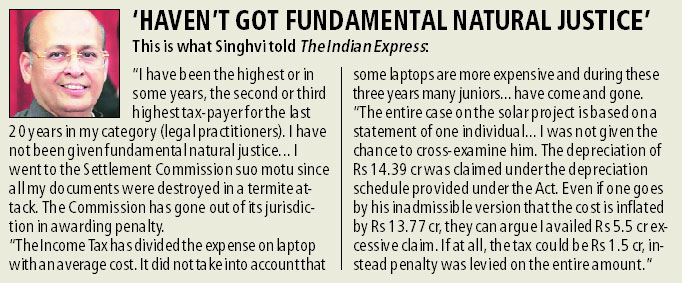
As first reported first by The Indian Express, Singhvi approached the Commission last year, seeking immunity from penalty and prosecution which has since been denied to him on some counts.
Singhvi moved the Jodhpur High Court which stayed a 103-page Commission order passed on September 11 this year.
"I have been the highest tax-payer among lawyers. Even in this case, the entire income was received by cheque, so were the expenses. So it is a case of over-expenditure and the department not agreeing to it. I went to the Settlement Commission suo motu before any survey or investigation started since I could not back up my claim due to destruction of records, and the loss of which I had reported to police before the I-T probe even began," Singhvi told The Indian Express.
The Singhvi tax case saw the Commission launching a full-fledged investigation into the expenses shown by the assessee. This is what the Commission highlighted:
> The sum has been added to Singhvi's professional taxable income since he took the plea that a termite attack on the premises of his chartered accountant in December 2012 destroyed all his records and expense vouchers/documents. This was not accepted by the Income Tax Department (ITD) and the Commission.
> The Commission's September order noted that since Singhvi's salary sheet had shown that he had employed 14 advocates/professionals to assist him, he would have had to purchase 1,250 laptops (each costing Rs 40,000) to account for the amount under that head.
> The Commission also probed Singhvi's claim that he spent Rs 35.98 crore on purchase of solar panels for his company, Rishab Enterprises. It declared that the transaction was "mainly intended at tax evasion by inflating the cost of the panels". Of Rs 25.16 crore said to have been paid by Singhvi, the company concerned admitted it received only Rs 21.39 crore. The owner of the company which sold the solar panels, and whose premises were searched by the ITD, gave a statement admitting that the cost was "inflated" and that Rs 10 crore was to be repaid to Singhvi in the form of a loan to his sons.
Incidentally, the Commission also challenged Singhvi's original contention — made at the first stage of his assessment — that the net income he earned from his legal practice was in the range of 55 per cent. The order noted the Income Tax contention that other equally senior Supreme Court lawyers had informed the tax department that their net income ranged between 90 per cent and 95 per cent.
The Commission also referred to the earlier probe by ITD in which several cheque payments made by Singhvi — to the tune of Rs 10.97 crore in the same three-year period — were found to be "non verifiable". Reason: When inquiry letters were sent to 91 parties, 37 were returned.
Following the Commission order, Singhvi approached the Jodhpur High Court which granted a stay. In his writ petition, he reiterated the stand he had taken before the tax authorities: "The record of the petitioner had been destroyed on account of termite attack and could not have established existing claims by bringing on record documentary evidence."
He said the loss of documents due to termite attack was reported to police on December 13, 2012. While contesting the I-T view, Singhvi's petition stated: "There is absolutely no finding of the commission to the effect that termite attack, consequent destruction of records or the police report in that regard is false, misleading, lack authenticity or is legally unsustainable."
Singhvi alleged that he had been "trapped" in a "cat and mouse game" and argued that the Commission did not have the jurisdiction to impose penalty on him. "No authority and power has been however been granted to the Settlement Commission in way of the provisions of Chapter XIX-A of the Act to impose and /or direct imposition of penalty under the provisions," petition stated.
On the issue of the solar power company, Singhvi's writ petition said: "No report could be furnished after 12 January 2014 being the expiry of the statutory period of 90 days for furnishing the report… DIT (Director, Income Tax investigation) Mumbai had no locus in the present proceeding… DIT Mumbai referred to ex parte enquiry conducted at Mumbai and is not tenable since the said statement was recorded under section 131 of the Act."

MUMBAI, NOV 12, 2014: THE issue before the Bench is - Whether provisions of Section 14A are attracted when investment is made by assessee in foreign subsidiary and dividend received on such investment is not tax free as per Section 10. And the answer goes against the assessee.
Facts of the case
The assessee had claimed certain amount as exempt income under section 10 but no disallowance was made under section 14A in the computation of income. During the assessment proceedings the Assessing Officer asked the assessee to give the working of disallowance under section 14A read with rule 8D. The assessee submitted written submissions and contended that in respect of tax exempt dividend income no borrowed fund was utilized for investing and further no expenditure was incurred in relation to the exempt income. However, without prejudice to the contentions the assessee, gave the working of disallowance under section 14A read with rule 8D. The Assessing Officer did not accept the contention of the assessee as no expenditure was incurred for earning the tax free income and made disallowance under section 14A by applying rule 8D.
In appeal, CIT(A) confirmed the action of the Assessing Officer in making the disallowance under section 14A.
Assessee submitted that the assessee's own fund was more than sufficient for investment which generated the tax free income. It was submitted that no disallowance in respect of interest expenditure was called for under section 14A when the assessee's own fund was more than sufficient for the investment during the year. It was further contended that for the assessment year 2007-08 and earlier years the Tribunal had remanded the matter to the record of the Assessing Officer for disallowance under section 14A in the light of decision of Jurisdictional High Court in the case of "Godrej & Boyce Manufacturing Co. Ltd. Vs. DCIT" 2010-TIOL-564-HC-MUM-IT and the Assessing Officer while passing the giving effect order of the Tribunal's direction had disallowed the administrative expenses at 0.25% of the investment and no disallowance was made in respect of interest expenditure. Therefore when no disallowance was made on account of interest expenditure under section 14A in the earlier year and the assessee's own fund was many times more than the investment made during the year then the action of the authorities below was unjustified. As regards the disallowance on account of administrative expenses, it was submitted that when the assessee had claimed that no expense had been incurred for earning the dividend income in question then in the absence of any satisfaction recorded by the Assessing Officer the disallowance made by the Assessing Officer was not sustainable. It was submitted that the majority of the investment during the year was in the subsidiary of the assessee and therefore to the extent of the investment in the subsidiary no disallowance of amount of administrative expenses could be made under section 14A. It was submitted that when the Assessing Officer has not established any nexus or connection of the expenditure with the exempt income then no disallowance can be made under section 14A.
Revenue contended that as per the provisions of section 14A read with rule 8D if the investment is made from the common pool fund then the interest expenditure has to be apportioned as per the formula given in the rule 8D. As regards the administrative expenses, when the assessee had made investment during the year then it could not be said that the assessee had not incurred any expenditure for earning the exempt income. It was submitted that the investment requires a decision making process and therefore in the absence of any services of portfolio manager the decision taken by the assessee clearly engaged its management as well as employees in the process. Therefore the disallowance under section 14A read with rule 8D was attracted.
In appeal, CIT(A) confirmed the action of the Assessing Officer in making the disallowance under section 14A.
Assessee submitted that the assessee's own fund was more than sufficient for investment which generated the tax free income. It was submitted that no disallowance in respect of interest expenditure was called for under section 14A when the assessee's own fund was more than sufficient for the investment during the year. It was further contended that for the assessment year 2007-08 and earlier years the Tribunal had remanded the matter to the record of the Assessing Officer for disallowance under section 14A in the light of decision of Jurisdictional High Court in the case of "Godrej & Boyce Manufacturing Co. Ltd. Vs. DCIT" 2010-TIOL-564-HC-MUM-IT and the Assessing Officer while passing the giving effect order of the Tribunal's direction had disallowed the administrative expenses at 0.25% of the investment and no disallowance was made in respect of interest expenditure. Therefore when no disallowance was made on account of interest expenditure under section 14A in the earlier year and the assessee's own fund was many times more than the investment made during the year then the action of the authorities below was unjustified. As regards the disallowance on account of administrative expenses, it was submitted that when the assessee had claimed that no expense had been incurred for earning the dividend income in question then in the absence of any satisfaction recorded by the Assessing Officer the disallowance made by the Assessing Officer was not sustainable. It was submitted that the majority of the investment during the year was in the subsidiary of the assessee and therefore to the extent of the investment in the subsidiary no disallowance of amount of administrative expenses could be made under section 14A. It was submitted that when the Assessing Officer has not established any nexus or connection of the expenditure with the exempt income then no disallowance can be made under section 14A.
Revenue contended that as per the provisions of section 14A read with rule 8D if the investment is made from the common pool fund then the interest expenditure has to be apportioned as per the formula given in the rule 8D. As regards the administrative expenses, when the assessee had made investment during the year then it could not be said that the assessee had not incurred any expenditure for earning the exempt income. It was submitted that the investment requires a decision making process and therefore in the absence of any services of portfolio manager the decision taken by the assessee clearly engaged its management as well as employees in the process. Therefore the disallowance under section 14A read with rule 8D was attracted.
Having heard the parties, the tribunal held that,
++ out of total investment of Rs.59.22 crore during the year the investment to the extent of Rs.33.80 crore is in the subsidiaries of the assessee. Further, even in the subsidiaries of the assessee the investment of Rs.32.80 crore has been made in CG International BV which is a foreign company and the dividend on such investment is not tax free as per the provisions of section 10. Therefore the provisions of section 14A are not attracted to the extent of the investment in the foreign company. Accordingly, we direct the Assessing Officer to exclude the investment made in the foreign company for the purpose of disallowance under section 14A. Now we will examine the fact whether the assessee had sufficient funds for the investment which generates the tax free income. As we have already noted that out of the total investment of Rs.59.22 crore during the year an investment of Rs.32.80 crore is in the foreign company and therefore after excluding the said investment the investment during the year generating the tax free income comes to Rs.26.42 crore only. From the analysis of the statement of source and application of fund as well as the balance sheet of the assessee, we find that there is an increase in the assessee's own fund to the tune of Rs.300 crore and at the same time there is a decrease in the loan funds during the year to the tune of Rs.228 crore. Therefore, even if its presumed that out of the Rs.300 crore increase in the assessee's own fund a sum of Rs.228 crore is used for repayment of the loan during the year, still the assessee would have a sum of Rs.72 crore available for investment. Since the investment in the domestic companies is only to the extent of Rs.26.42 crore during the year, therefore the assessee's own fund is more than sufficient to meet the investment during the year. Accordingly, we are of the view that no disallowance under section 14A is called for on account of interest expenditure when the assessee's own fund is more than sufficient for the investment generating tax free income;
++ as regards the disallowance of administrative expenses, we do not accept the contention of the assessee that no expenditure has been incurred by the assessee for earning the dividend income. For taking an investment decision a high level thought process is required and therefore when the assessee has made investment during the year the provisions of section 14A are applicable on account of administrative expenses. However, as we have noted that out of the total investment of Rs.59.22 crore a sum of Rs.33.80 crore has been invested in the subsidiary companies, therefore for the purpose of disallowance under section 14A by applying rule 8D the investment made in the subsidiaries and in the foreign company shall be excluded. The apportionment of the administrative expenses can be made only by considering the investment in the domestic companies other than the subsidiary company. Therefore, we direct the Assessing Officer to recompute the disallowance under section 14A in respect of the administrative expenses by excluding the investment in the subsidiaries and in the foreign companies.
++ out of total investment of Rs.59.22 crore during the year the investment to the extent of Rs.33.80 crore is in the subsidiaries of the assessee. Further, even in the subsidiaries of the assessee the investment of Rs.32.80 crore has been made in CG International BV which is a foreign company and the dividend on such investment is not tax free as per the provisions of section 10. Therefore the provisions of section 14A are not attracted to the extent of the investment in the foreign company. Accordingly, we direct the Assessing Officer to exclude the investment made in the foreign company for the purpose of disallowance under section 14A. Now we will examine the fact whether the assessee had sufficient funds for the investment which generates the tax free income. As we have already noted that out of the total investment of Rs.59.22 crore during the year an investment of Rs.32.80 crore is in the foreign company and therefore after excluding the said investment the investment during the year generating the tax free income comes to Rs.26.42 crore only. From the analysis of the statement of source and application of fund as well as the balance sheet of the assessee, we find that there is an increase in the assessee's own fund to the tune of Rs.300 crore and at the same time there is a decrease in the loan funds during the year to the tune of Rs.228 crore. Therefore, even if its presumed that out of the Rs.300 crore increase in the assessee's own fund a sum of Rs.228 crore is used for repayment of the loan during the year, still the assessee would have a sum of Rs.72 crore available for investment. Since the investment in the domestic companies is only to the extent of Rs.26.42 crore during the year, therefore the assessee's own fund is more than sufficient to meet the investment during the year. Accordingly, we are of the view that no disallowance under section 14A is called for on account of interest expenditure when the assessee's own fund is more than sufficient for the investment generating tax free income;
++ as regards the disallowance of administrative expenses, we do not accept the contention of the assessee that no expenditure has been incurred by the assessee for earning the dividend income. For taking an investment decision a high level thought process is required and therefore when the assessee has made investment during the year the provisions of section 14A are applicable on account of administrative expenses. However, as we have noted that out of the total investment of Rs.59.22 crore a sum of Rs.33.80 crore has been invested in the subsidiary companies, therefore for the purpose of disallowance under section 14A by applying rule 8D the investment made in the subsidiaries and in the foreign company shall be excluded. The apportionment of the administrative expenses can be made only by considering the investment in the domestic companies other than the subsidiary company. Therefore, we direct the Assessing Officer to recompute the disallowance under section 14A in respect of the administrative expenses by excluding the investment in the subsidiaries and in the foreign companies.
Income tax law in India | |
Posted: 11 Nov 2014 05:48 AM PST
Subash Agarwal, Advocate
CA Swati Baid
INTRODUCTION
In India, people have immense faith in God and thus some amount of money is always deployed by people for Him. People, on regular basis, expend certain amount of money in performing different types of puja. These expenses are debited while preparing the Profit and loss account of the business concern of a person. But whether the same is allowed as deduction while computing the total income of the assessee for the Income Tax purpose? This question has always been in controversy and various judgements have been pronounced, both in favour and against the view that the expenses incurred in relation to the any puja can be claimed as deduction under the Income Tax Act.
EXPENSES ALLOWABLE UNDER THE INCOME TAX ACT
In Income Tax Act, a person can claim the deduction of an expense from the income derived from business and profession. The expenses which are incurred for the business purpose are only allowed as deduction u/s 30 to 44 DB of the I.T.Act, 1961. Not all but specific expenses are only allowed as deduction as business expenses in the Income Tax. However, there is a residuary section, sec 37(1), under which the expenses not covered under the specific sections 30 to 36, the deduction for those expenses can be claimed under this section provided certain other conditions are fulfilled.
As per sec. 37(1) Any expenditure (not being expenditure of the nature described in sections 30 to 36 and not being in the nature of capital expenditure or personal expenses of the assessee, laid out or expended wholly and exclusively for the purposes of the business or profession shall be allowed in computing the income chargeable under the head "Profits and gains of business or profession".
Thus, for claiming the deduction u/s 37(1) of the Act following conditions are to be fulfilled:
· Such expenditure should not be covered under the specific sections i.e. sections 30 to 36
· The expenditure should not be of capital nature
· The expenditure should be incurred during the previous year
· The expenditure should not be of personal nature
· The expenditure should have been incurred wholly and exclusively for the purpose of the business or profession
· The business should be commenced.
The expenses incurred by the assessee in relation to any puja performed especially during the inauguration of the new office and at the time of Diwali Pujan do not fall under any specific Sec of the I.T.Act where the deduction of the same can be claimed. But, the same can be claimed as deduction under the residuary sec 37(1) of the Act provided the abovementioned conditions are fulfilled.
ADVERSE VIEW
However, various courts have taken a contrary view and have upheld disallowance of expenses relating to any puja treating them either as a personal expense of the director of the company and not the business expenditure. The High Court of Karnataka in the case of Sanghameshwar Coffee Estates Ltd. [1986] 160 ITR 203 and the Bombay High Court in the case of Kolhapur Sugar Mill Ltd. [1979] 119 ITR 387 has held that pooja is performed by the followers of a particular religion or faith. A company, which is only a juristic person, cannot claim to profess, practice, or follow any religion or faith. It was held that a company, which is a creation by legal fiction and not a real person made up of flesh and blood, cannot profess any religion and therefore, performance of pooja cannot be said to be the need of business.
However, the High Courts in the above cases did not consider the fact that any expenditure incurred by the director for or on behalf of the company has to be treated as a business expense. The pooja performed would motivate the employees and workers to contribute to the development and progress of the business of the company.
FAVOURABLE VIEW
The Punjab and Haryana High Court in the case of Atlas Cycle Industries Ltd. [1982] 134 ITR 458 has held that "no curbs can be placed on the discretion of the assessee to provide the type of recreation, which, according to it, would best advance the interest of the business. If the recreation provided, even if it is in the nature of the religious activity, has direct nexus with the welfare of a class of workers engaged by the assessee, it is wholly immaterial if the recreation provided is directly or indirectly connected with the religious tenets of a section of the society".
Reliance can be placed in the case of Brijramandas and Sons [1983] 142 ITR 509 wherein the Allahabad High Court has held that Ganeshjiki Pooja expenses, which Hindu traders do in a customary way at the time of Mahurat or opening of their account books on the auspicious occasion of Diwali, are to be treated as expenditure laid out wholly and exclusively for the purpose of assessee's business and is therefore allowable u/s 37(1) of the Income Tax Act, 1961.
AMBIGUOUS CBDT CIRCULAR
CBDT in its Circular no. 13/A/20/68-IT(A-II) dated 3.10.1968 has stated that as the expenses incurred on the occasion of Diwali and mahurat are in the nature of business expenditure, it has been decided not to lay down any monetary limits for the purpose of their allowance in the income-tax assessments subject to the Income-tax Officer being satisfied that the expenses are admissible as a deduction under the law and are not expenses of a personal, social or religious nature.
CONCLUSION
In our opinion, puja expenses incurred by the assessees are not personal expenses and are incurred wholly and exclusively for the business and should be allowed as deduction u/s 37(1) of the Act. Judiciary has taken different views on different occasions and CBDT circular has confounded the problem by giving the discretion to the assessing officer in the matter.
Thus, one has to wait for the authoritative pronouncement from the Supreme Court in the matter to clinch the issue. It is better that the business associations/ chambers of commerce can request the CBDT to unambiguously clarify the allowability of the same. After all, people's faith in the providence to bring prosperity through business has inextricable linkage with the business of the assessee and as rightly held by the Punjab & Haryana High Court, puja is a sort of recreation provided to the employees.
__._,_.___


No comments:
Post a Comment